

Introduction
Amid a biodiversity crisis and mounting pressure from civil society and regulators, companies and financial institutions face growing calls to measure, manage, and reduce their impacts[1] on biodiversity. However, unlike the GHG Protocol for carbon, there are still no standardised, operational guidelines for measuring and tracking biodiversity impacts at corporate and portfolio level. Several initiatives are actively helping to bridge the gap: the Taskforce on Nature-related Financial Disclosures (TNFD), the Science Based Targets Network (SBTN), the Align project, and the Nature Positive Initiative (NPI) are laying the groundwork on which facets of biodiversity should be measured, and what supply-chain-level approaches corporates should aim for.
To contribute to these discussions, CDC Biodiversité and I Care launched a joint effort in 2025 to develop a common set of rules and good practice for biodiversity impact accounting. Both aim to bring a practical perspective to the debate, drawing on their expertise as developers of biodiversity-footprinting tools and practitioners, supporting companies and financial institutions on their biodiversity journey. Grounded in science, this work builds on the frameworks mentioned above to propose harmonised accounting principles, underpinning robust and actionable assessments and comparability in the long run.
Three documents have been produced so far; the key messages are summarised below.
[1] Defined here as the negative or positive effect of business activity on biodiversity (source: UNEP-WCMC et al., 2022. Recommendations for a Standard on Corporate Biodiversity Measurement and Valuation, Aligning Accounting Approaches for Nature)
Scoping note: Objectives and core concept
Establishes the key concepts on which all this accounting work is based.
What is measured. Among the many facets of biodiversity, we consider ecosystem condition the most relevant angle for assessing corporate impacts to date. It is a good indicator of broader ecosystem health[1], features in global frameworks[2], and aligns with the widely used international standard for environmental accounting[3]. It is also the dimension of biodiversity modelled by the most mature tools. Tracking other dimensions, such as species, nonetheless remains pivotal to a comprehensive picture—one that avoids masking other impacts[4]. We believe many of this project’s conclusions can be transposed to those dimensions.
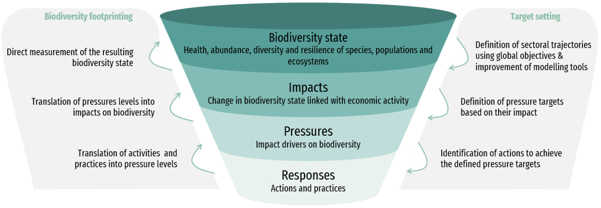
How it is measured. The focus is on impact assessment through biodiversity footprinting, i.e., quantifying the “impact of a portfolio, asset class, project or company measured in terms of biodiversity change as a result of production and consumption of particular goods and services”[5]. In the state-impact-pressure-response framework, impact assessments can be informed both by field measurements of the state of nature and derived from pressure data (e.g., water use, GHG emissions) through pressure-impact modelling.
Scoping an organisation’s biodiversity footprint
Aligns ecosystem condition accounting with carbon reporting by adapting GHG Protocol concepts and principles.
- Adapts the Scope framework from the GHG Protocol to biodiversity footprinting, with practical guidance on how Scope boundaries and categories should be modified to reflect the specificities of ecosystem condition impacts.
- Promotes traceability and consistency in boundary-setting and asset accounting. Guidance is offered to ensure consistency in how assessment boundaries are defined and how assets are accounted for along their life cycles, including where responsibilities are shared between multiple stakeholders. Adopting common rules is key to comparability, transparency and consistent tracking over time
[New!] From measurement to credible claims: the complementary roles of field and modelled data in corporate biodiversity assessments
With contributions from NatureMetrics, this report showcases a key strength of biodiversity footprinting – its ability to combine field- and model-based data – and lays the foundations of the associated corporate guidance.
Ecological field data is essential to measuring biodiversity accurately and in a way that supports action. Corporates are engaging with it increasingly—through their own projects or via nature credits—creating a need for guidance on how to value and integrate it into corporate biodiversity assessments.
Monitoring impacts on ecosystem condition in the field. A growing range of techniques can assess different dimensions of ecosystem condition, with varying accuracy, scalability and suitability for impact accounting. The publication explores how observations can be translated into corporate impact assessments, addressing impact attribution, heterogeneous metrics and consolidation into common accounts.
Complementarity of field monitoring and models across the value chain. Field monitoring is the gold standard for tracking the state of nature, but its costs require prioritisation. It should focus on sites of greatest environmental materiality where the organisation’s influence is sufficient to turn data into site-specific management action. Modelling approaches fill the gaps and support a value-chain-wide strategy.
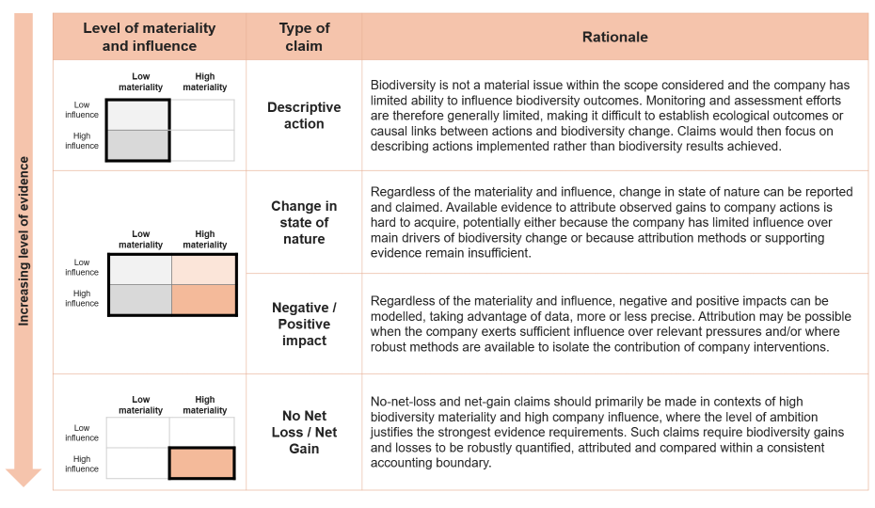
Claim credibility rests on measurement method and evidence. Corporate claims range from commitments, to ecological outcomes, to netting. Each requires different evidence, while all require clear disclosure of scope and uncertainties. Organisations are encouraged to set claim ambition pragmatically, aligning claims with feasible measurement efforts to avoid overstatements.
Looking ahead, next steps and remaining questions
- Claims: further operationalise the guidance, notably impact attribution.
- Corporate trajectories: strengthen how they are built, accounting for differences in temporalities and setting rules for weighing impacts against gains.
Who are we?
CDC Biodiversité and I Care are long-standing developers of biodiversity footprinting tools, recognised in international frameworks and voluntary initiatives. Well connected to scientific, technical and institutional partners, they have a long history of R&D efforts and engagement with companies, financial institutions and public authorities. Their alliance also benefits from CDC Biodiversité’s expertise in ecological restoration and active involvement in international methodological initiatives, including Align and the EU’s Expert Group on Nature Credits.
How to get involved?
These reports are only the first steps. We are open to methodological discussions and to setting up pilots—collaborating with a broad range of stakeholders is essential to advance this work, so please reach out to gbs@cdc-biodiversite.fr and contact@i-care-consult.com.
[1] Smith et al., 2017. How Natural Capital Delivers Ecosystem Services: A Typology Derived from a Systematic Review.
[2] Convention on Biological Diversity, 2022. Kunming-Montreal Global Biodiversity Framework.
[3] United Nations, 2021. System of Environmental-Economic Accounting—Ecosystem Accounting (SEEA EA).
[4] Nature Positive Initiative, 2026. Draft Measurement Guidance Executive Summary: State of Nature Metrics—February 2026.
[5] PBAF, 2022. Taking Biodiversity into Account, PBAF Standard V2022—Biodiversity Impact Assessment—Footprinting.